


Choosing the best dog breeds for your lifestyle is not just about size, color, or looks. A dog’s personality can change your whole daily routine. Some dogs are calm and quiet. Some need long walks, games, and training every day.
Two dogs can be the same size but act completely differently. One small dog may bark all day. Another small dog may sleep beside you quietly.
That is why dog types by personality matter. When you choose by personality, you have a better chance of finding a dog that fits your home, time, kids, energy, and patience.
Quick Answer: Main Dog Types by Personality
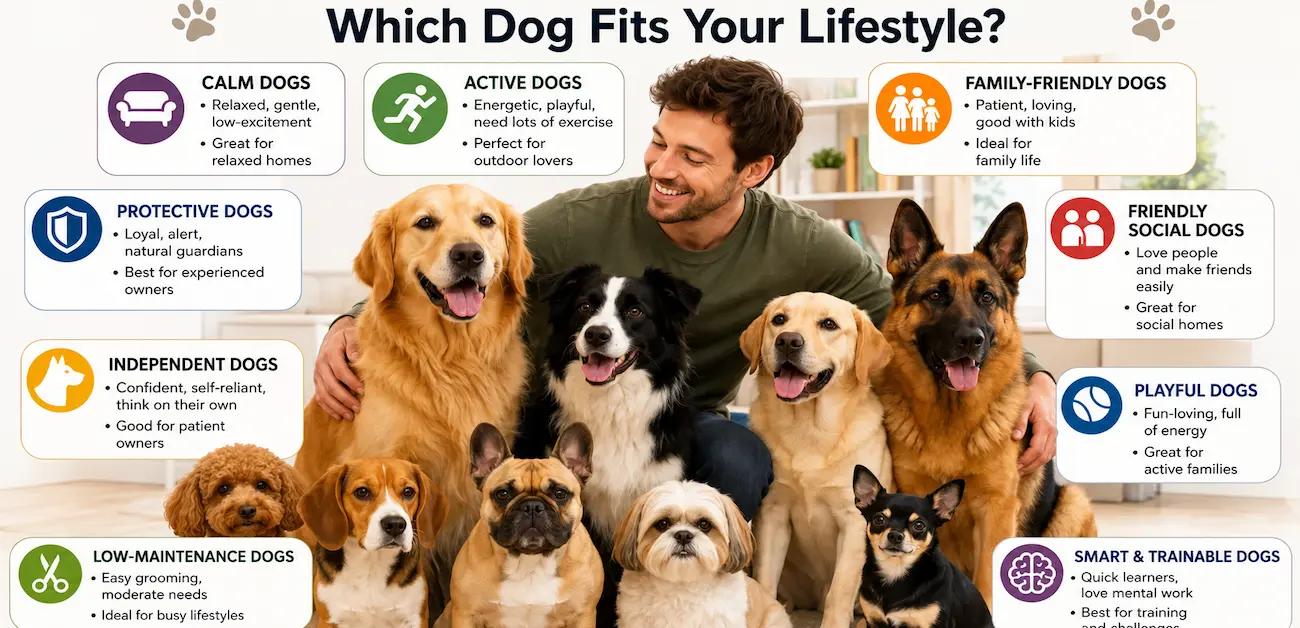
The main dog types by personality include calm dogs, active dogs, family-friendly dogs, protective dogs, friendly social dogs, independent dogs, playful dogs, low-maintenance dogs, smart trainable dogs, and sensitive dogs.
The best type depends on your real life. A busy person may need a calmer dog. An outdoor owner may enjoy an active breed. A family with kids may need a patient, social, and trainable dog.
No personality type is perfect for everyone. The right dog is the one you can care for every day, not just the one you like in photos.
Choosing a Dog Based on Personality
Let’s imagine a couple named Mark and Sarah. They live in a small home in Ohio. Mark wants a dog that can go on weekend hikes. Sarah wants a calm dog that can relax indoors while she works from home.
They both like Golden Retrievers, French Bulldogs, and Australian Shepherds. At first, they only look at photos. Every breed looks cute. But then they start asking better questions. Can this dog stay calm indoors?
Will it bark too much?
How much exercise does it need?
Can it live with children later?
Is grooming easy?
Can it be left alone for a few hours?
That is when they realize something important. They do not just need a breed. They need the right personality type. So they compare dogs by energy, barking, grooming, family fit, training needs, and apartment fit. That simple step helps them avoid a poor match.
Why Dog Personality Matters More Than Looks

Many people choose a dog because it looks cute. That is normal. A fluffy puppy or strong-looking dog can grab your attention fast. But looks do not show daily behavior. One small dog may bark all day. Another small dog may sleep beside you quietly.
A beautiful dog can still be too loud, too energetic, too stubborn, or too needy for your home. That is why choosing the best dog breeds for your lifestyle matters more than picking by looks alone. Personality affects your whole day.
It affects walks, sleep, training, noise, visitors, kids, cleaning, and stress. A wrong match can make both the owner and the dog unhappy. For example, a Border Collie may look amazing. But if you cannot give it mental work and exercise, it may become restless.
A French Bulldog may look easy. But it still needs care, training, and attention. A German Shepherd may look protective. But without training, that protection can become hard to manage. So, before choosing a breed, compare dog types by personality and ask this: What type of dog fits my actual life?
Calm Dog Types
Calm dogs are usually best for relaxed homes, seniors, quiet families, and people who do not want a high-energy pet. These dogs often enjoy short walks, slow routines, and plenty of rest. Still, calm does not mean lazy.
Every dog needs movement, training, and attention. A calm dog can still bark, chew, or become anxious if ignored. Good calm dog breeds include Great Dane, Cavalier King Charles Spaniel, Basset Hound, Shih Tzu, Newfoundland, and Bernese Mountain Dog.
Great Danes are giant but often relaxed indoors. Shih Tzus are small companion dogs that enjoy calm homes. Basset Hounds are slow-moving but can be stubborn. Newfoundlands and Bernese Mountain Dogs can be loving family dogs, but they need space and grooming.
Best for: Quiet homes, seniors, calm families, and owners who enjoy a slower routine. Watch for: Weight gain, stubborn behavior, grooming needs, and lack of exercise.
Active Dog Types
Active dogs are best for people who enjoy walking, hiking, running, training, and outdoor time. These dogs need more than a quick trip outside. They need daily movement. Many also need mental work, such as training games, fetch, scent work, or puzzle toys.
Good active dog examples include Border Collie, Australian Shepherd, Labrador Retriever, German Shorthaired Pointer, Siberian Husky, and Jack Russell Terrier. These dogs can be amazing in the right home.
But in the wrong home, they can become loud, bored, and destructive. An Australian Shepherd may chase, bark, or herd kids if it does not have a job. A Husky may escape if the yard is weak. A Jack Russell may dig or bark if bored.
Best for: Outdoor owners, active families, runners, hikers, and training-focused owners. Watch for: Boredom, barking, chewing, digging, and high exercise needs.
Family-Friendly Dog Types

Family-friendly dogs are usually social, patient, trainable, and good with children when raised properly. This does not mean any dog should be left alone with young kids. Adult supervision always matters.
Good family dogs include the Golden Retriever, Labrador Retriever, Beagle, Boxer, Collie, and Bernese Mountain Dog. Golden Retrievers and Labradors are popular because they are friendly and eager to please. Beagles are cheerful and playful, though they can be vocal.
Boxers are fun and loyal, but they can be bouncy. Collies are gentle and watchful. Bernese Mountain Dogs are affectionate but shed heavily. A good family dog should match the age of your children. Toddlers need calmer dogs. Older kids can handle more playful breeds.
Best for: Families with kids, social homes, and owners who can train early. Watch for: Jumping, rough play, barking, and poor child-dog boundaries.
Protective Dog Types
Protective dogs are loyal, alert, and often very bonded to their family. They can be great for experienced owners who know how to train and socialize them. But protective does not mean aggressive.
A good protective dog should be stable, controlled, and well-socialized. It should not react to every guest, sound, or stranger. Examples include German Shepherd, Rottweiler, Doberman Pinscher, Mastiff, Great Pyrenees, and Cane Corso.
These dogs need clear leadership and calm training. They should meet different people, places, sounds, and situations early in life. A protective dog in the wrong home can become stressful. It may bark too much, guard people, or act unsure around visitors.
Best for: Experienced owners, structured homes, and people who can train consistently. Watch for: Poor socialization, overprotective behavior, pulling, barking, and stranger reactivity.
Friendly Social Dog Types
Friendly social dogs love people. They often enjoy visitors, family gatherings, walks, and meeting other dogs. These dogs can be great for outgoing homes. But some become too excited if not trained.
Examples include Labrador Retriever, Golden Retriever, Havanese, Cocker Spaniel, Poodle, and Cavalier King Charles Spaniel. A social dog may follow you from room to room. It may greet guests with excitement. It may also struggle if left alone too long.
That is why training calm greetings matters. Friendly dogs still need manners. A jumping Labrador can knock over a child even if it is only being happy.
Best for: Social families, first-time owners, friendly homes, and people who want a companion. Watch for: Separation anxiety, jumping, overexcitement, and needing lots of attention.
Independent Dog Types

Independent dogs can think for themselves. They are not always clingy. They may enjoy their owner but still want space. Some people love this. Others find it frustrating.
Examples include Akita, Shiba Inu, Basenji, Chow Chow, Great Pyrenees, and Afghan Hound. Independent dogs often need patient owners.
They may not obey as quickly as a Labrador or Golden Retriever. That does not mean they are not smart. It means they may ask, “Why should I do that?” Training should be calm, clear, and consistent.
Harsh handling usually makes things worse. Independent dogs can be good for people who do not want a needy pet. But they are not always best for first-time owners.
Best for: Patient owners, quiet homes, and people who like less clingy dogs. Watch for: Stubborn behavior, slower training, poor recall, and aloofness with strangers.
Playful Dog Types
Playful dogs bring fun into the home. They enjoy games, toys, kids, and family activities. These dogs can be great for active families. But they may be too much for very quiet homes. Examples include Boxer, Beagle, French Bulldog, Corgi, Boston Terrier, and Labrador Retriever.
A playful dog needs time. If nobody plays with it, the dog may make its own fun. That can mean chewing, barking, stealing socks, or chasing kids around the house. Playful dogs also need rules.
A Boxer may jump. A Corgi may nip at heels. A Beagle may follow its nose and ignore you outside. Fun is good. But structure makes it safe.
Best for: Families, playful owners, older kids, and people who enjoy daily interaction. Watch for: Jumping, barking, rough play, and boredom.
Low-Maintenance Dog Types
Low-maintenance dogs are often easier in daily care, but no dog is zero effort. Every dog needs food, vet care, exercise, grooming, training, and attention. A low-maintenance dog usually has moderate exercise needs, easier grooming, and a calmer routine.
Examples include Greyhound, Dachshund, Chihuahua, French Bulldog, Boston Terrier, and Great Dane. Greyhounds are often calm indoors after a walk. Chihuahuas are small but still need training. Boston Terriers are friendly and easy to groom.
French Bulldogs are popular, but owners must understand breathing and heat concerns. Great Danes have short coats and calm indoor behavior, but their size makes food and vet care expensive.
Best for: Busy owners, apartment homes, seniors, and people who want simpler daily care. Watch for: Health issues, weight gain, heat sensitivity, and assuming “easy” means no work.
Smart and Trainable Dog Types

Smart dogs learn quickly. That sounds perfect, but there is a catch. A smart dog also gets bored quickly. Examples include Border Collie, Poodle, German Shepherd, Golden Retriever, Labrador Retriever, and Australian Shepherd.
These dogs often do well with training, sports, tricks, and jobs. They enjoy learning and working with people. But if you do not train them, they may train you instead.
A smart dog can learn good habits fast. It can also learn bad habits fast. For example, it may learn how to open doors, steal food, bark for attention, or escape the yard. Smart dogs need mental work, not just physical walks.
Best for: Training lovers, active owners, families who enjoy teaching, and people who want a responsive dog. Watch for: Boredom, anxiety, barking, and needing daily mental work.
Sensitive Dog Types
Sensitive dogs feel things deeply. They may react strongly to loud voices, rough handling, stress, or sudden changes. These dogs often bond closely with their owners. They can be very loving in calm homes.
Examples include Collie, Cavalier King Charles Spaniel, Whippet, Italian Greyhound, Shetland Sheepdog, and some Spaniel breeds. Sensitive dogs usually do best with gentle training.
They do not respond well to yelling or harsh corrections. A soft voice, routine, and reward-based training often work better. These dogs can be wonderful for kind, patient owners. But busy, loud, chaotic homes may stress them.
Best for: Gentle owners, calm homes, seniors, and people who like close bonding. Watch for: Fearfulness, stress, separation anxiety, and noise sensitivity.
Comparison Table
Dog Personality Type | Best For | Energy Level | Training Need | Good for Kids? | Apartment Fit | Watch For |
|---|---|---|---|---|---|---|
Calm dogs | Quiet homes, seniors | Low to medium | Basic | Often good | Good | Weight gain, stubbornness |
Active dogs | Outdoor owners | High | High | Depends on breed | Usually harder | Boredom, chewing |
Family-friendly dogs | Homes with kids | Medium | Medium | Yes, with supervision | Depends on size | Jumping, rough play |
Protective dogs | Experienced owners | Medium to high | High | With training | Usually harder | Overprotective behavior |
Friendly social dogs | Social homes | Medium | Medium | Often good | Good | Separation anxiety |
Independent dogs | Patient owners | Medium | Medium to high | Depends on breed | Depends | Stubborn behavior |
Playful dogs | Active families | Medium to high | Medium | Often good | Good with training | Barking, jumping |
Low-maintenance dogs | Busy owners | Low to medium | Basic to medium | Depends on breed | Often good | Health issues |
Smart trainable dogs | Training lovers | Medium to high | High | Often good | Depends | Mental boredom |
Sensitive dogs | Gentle homes | Low to medium | Gentle training | Often good | Good | Stress, fearfulness |
How to Match a Dog Type With Your Lifestyle

Start with your home. If you live in an apartment, look for a dog with lower barking, moderate energy, and smaller space needs. Good options may include Cavalier King Charles Spaniel, Shih Tzu, Greyhound, Boston Terrier, or Havanese.
If you have kids, look for patience, trainability, and a social nature. Golden Retrievers, Labradors, Collies, Beagles, and Bernese Mountain Dogs can be good choices for many families. If you work long hours, avoid breeds that struggle badly when alone.
Some social dogs become anxious if left alone every day. You may need dog daycare, a walker, or a more independent breed. If you love hiking, choose an active dog. Labradors, Australian Shepherds, German Shorthaired Pointers, and Border Collies can enjoy active homes.
If you are a first-time owner, avoid very strong protective breeds unless you are ready for training. A friendly, trainable, moderate-energy dog is often easier. If grooming time is limited, look for easier coats. Short-coated dogs may save time, but remember that short hair can still shed.
If you want less barking, research carefully. Some small breeds are louder than large breeds. Size does not predict noise.
Common Mistakes People Make
The first mistake is choosing by looks only. A cute dog may not fit your schedule, home, or patience level. The second mistake is ignoring the energy level.
A high-energy dog in a low-energy home often becomes stressed and destructive. The third mistake is underestimating barking.
This matters a lot in apartments, shared walls, and quiet neighborhoods. The fourth mistake is choosing a protective dog without experience.
Protective breeds need socialization, structure, and confident handling. The fifth mistake is picking a smart dog without time for training.
Smart dogs need mental work. Without it, they may become difficult. The sixth mistake is thinking small dogs are always easy.
Some small dogs bark more, need more grooming, or have big personalities.
The seventh mistake is ignoring grooming needs. A fluffy dog may need brushing, trimming, and regular coat care.
The eighth mistake is not checking real breed temperament. Photos show looks. Temperament shows daily life.
Final Verdict: Which Dog Type Fits Your Lifestyle?
The best choice depends on how you live every day. Calm dogs are best for quiet homes, seniors, and relaxed families. Active dogs are best for outdoor owners who enjoy daily exercise. Family-friendly dogs are best for homes with children and steady routines.
Protective dogs are best for experienced owners who can train and socialize early. Friendly social dogs are best for people who want a loving companion. Independent dogs are best for patient owners who do not want a clingy pet. Playful dogs are best for families that enjoy games and daily activity.
Low-maintenance dogs are best for people who want a simpler routine. Smart dogs are best for owners who enjoy training and mental games. Sensitive dogs are best for gentle homes with calm handling.
In the end, the best dog breeds for your lifestyle are the ones that match your home, schedule, energy level, grooming time, and training ability. Choose the dog you can care for properly. That is how you find a dog that fits your life, not just your eyes.
FAQs About Dog Types by Personality
What are the main dog types by personality?
The main dog types by personality include calm, active, playful, protective, social, independent, sensitive, and trainable dogs. Each type fits a different home and routine.
Which dog personality is best for families?
A patient, social, and trainable dog is usually best for families. Golden Retrievers, Labradors, Collies, and Beagles are common family-friendly choices.
What dog type is best for first-time owners?
Friendly, trainable, and moderate-energy dogs are often best for first-time owners. Avoid very protective or very high-energy breeds unless you are ready for training.
What dog type is best for apartments?
Calm dogs with lower barking and moderate exercise needs usually fit apartments better. Shih Tzus, Cavaliers, Greyhounds, Boston Terriers, and Havanese can work well.
Are calm dogs easier to own?
Calm dogs can be easier for many homes, but they still need walks, training, and care. Calm does not mean no responsibility.
Which dog types need the most exercise?
Active and working dog types need the most exercise. Border Collies, Australian Shepherds, Huskies, and German Shorthaired Pointers need daily movement and mental work.
