


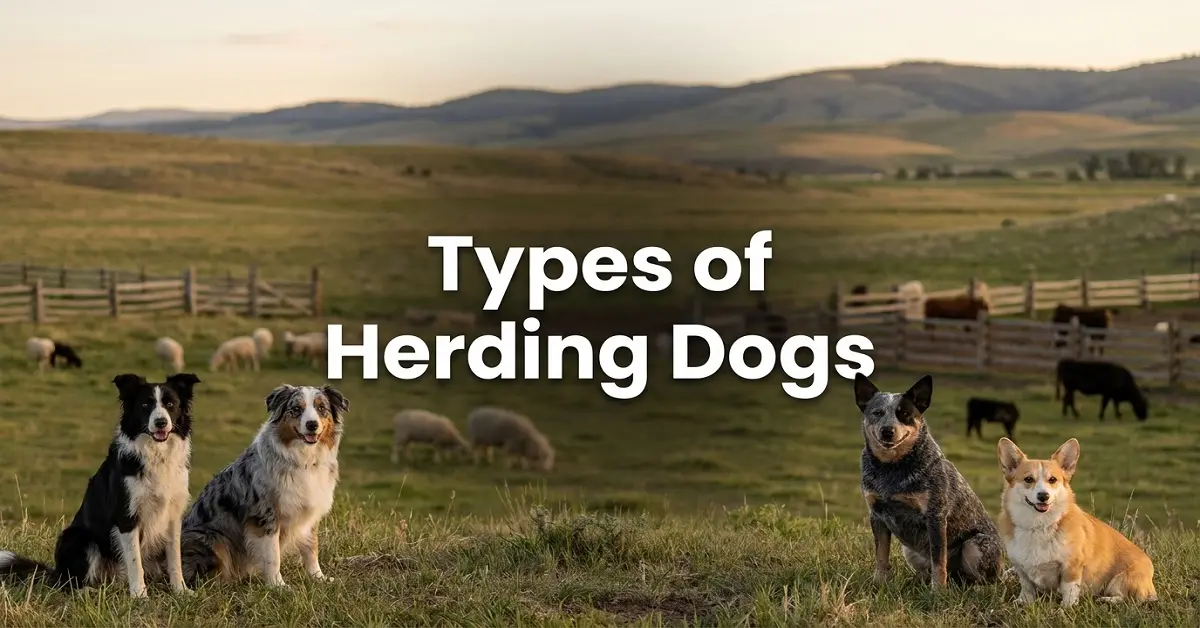
Types of herding dogs vary by size, temperament, coat, and the way they control livestock. Some gather sheep from a distance. Others drive cattle from behind. Some stay near the herd and keep animals inside a set area.
Today, many herding dogs live as family pets. Still, their working instincts remain strong. That means they need regular activity, training, and mental work.
What Is a Herding Dog?
Herding dogs were bred to help people move and control livestock such as sheep, cattle, and goats. Over many generations, breeders selected dogs that could watch animal movement, respond to human signals, and control a herd without causing serious harm.
The American Kennel Club places herding breeds in its Herding Group. The group includes well-known dogs such as the Border Collie, Australian Shepherd, German Shepherd Dog, Australian Cattle Dog, Collie, and Welsh Corgis.
These dogs often share several traits:
- High energy
- Strong work drive
- Quick learning
- Close bonds with people
- Strong awareness of movement
- A natural instinct to control or chase moving animals
However, breed traits can differ a lot. A small Shetland Sheepdog has very different needs from a German Shepherd or Australian Cattle Dog.
Types of Herding Dogs by Working Style
Herding dogs do not all work in the same way. Their jobs can generally be grouped into fetching, driving, and tending. Some breeds can use more than one style.

| Herding style | What the dog does | Common examples |
| Fetching | Circles around livestock and brings the group back to the handler | Border Collie, Shetland Sheepdog |
| Driving | Pushes livestock forward from behind, often using movement or heel-nipping | Australian Cattle Dog, Corgi, Australian Shepherd |
| Tending | Keeps livestock inside a set area and stops animals from straying | German Shepherd, Belgian Malinois, Beauceron |
Fetching Dogs
Fetching dogs gather livestock and bring it back toward the handler. The Border Collie is a classic example. It often uses controlled movement and an intense gaze to influence sheep.
Driving Dogs
Driving dogs move livestock forward. Some, such as the Australian Cattle Dog and Corgi, may nip at heels to keep cattle moving. This working style helped dogs move animals across farms and long distances.
Tending Dogs
Tending dogs work more like a moving boundary. They help keep livestock inside a specific area and stop animals from wandering away. German Shepherds and Belgian Malinois are examples of breeds that can show this style.

Popular Herding Dog Breeds
Here are some of the best-known herding dog breeds in the US.
| Breed | Main traits | Common fit |
| Border Collie | Very intelligent, focused, energetic | Farms, dog sports, active owners |
| Australian Shepherd | Athletic, alert, eager to work | Farms, sports, active families |
| Australian Cattle Dog | Tough, alert, loyal, energetic | Farms and experienced owners |
| German Shepherd | Intelligent, confident, versatile | Active families, work, service roles |
| Shetland Sheepdog | Small, lively, trainable | Active families and dog sports |
| Pembroke Welsh Corgi | Small, alert, energetic | Families and active homes |
| Cardigan Welsh Corgi | Smart, sturdy, adaptable | Families and active owners |
| Belgian Malinois | Athletic, focused, highly driven | Experienced handlers and working roles |
| Collie | Intelligent, social, trainable | Families and active homes |
| Old English Sheepdog | Strong, friendly, heavy-coated | Families able to manage grooming |
The Border Collie stands out for its gathering style and strong working focus. The Australian Cattle Dog, meanwhile, was developed for cattle work and still needs plenty of physical and mental activity.
The Australian Shepherd is another active breed. Despite its name, the breed developed in the United States and has a strong instinct to herd moving animals, including children and other pets.
The AKC also recognizes many less common herding breeds, including the Bergamasco Sheepdog, Berger Picard, Finnish Lapphund, Mudi, Pumi, Pyrenean Shepherd, Spanish Water Dog, and Swedish Vallhund.
Herding Dogs as Family Pets
A herding dog can make a great family companion, but breed choice matters.
These dogs often bond closely with their owners. They also notice movement quickly. As a result, some may chase bicycles, cars, other pets, or running children. Some may also circle or nip at heels because of their herding instinct.
That behavior does not automatically mean aggression. It is often linked to the dog’s working instincts.
For a family home, look beyond appearance. Consider the dog’s activity level, training needs, size, coat, and temperament. A busy household may suit an active herding breed, while a less active home may struggle with a dog bred to work for hours.
Training and Exercise for Herding Dogs

Training should start early. Prioritize impulse control, socialization, fundamental obedience, recall, and composed conduct.
Because herding dogs learn quickly, training can become part of their daily mental exercise. Puzzle toys, scent work, agility, obedience, herding trials, and other dog sports can give them a useful outlet.
Also, give your dog clear rules and a steady routine. If a herding dog has little physical or mental activity, unwanted behaviors can appear. Chasing, barking, circling, and heel-nipping are common examples.
Health and Care
Health needs depend on the breed. For example, the AKC lists hip and eye evaluations among the recommended tests for Border Collies. Australian Shepherds have recommendations that include hip, elbow, and eye evaluations. Collies have several recommended genetic tests, including MDR1 and tests related to inherited eye conditions.
Some herding breeds can also carry the MDR1 gene variant, which can affect how the body handles certain medicines. This is especially relevant in breeds such as Collies, Australian Shepherds, Border Collies, and Shetland Sheepdogs.
Regular veterinary care matters too. Keep up with routine checkups, grooming, dental care, vaccinations, parasite prevention, and breed-specific screening.
FAQs About Types of Herding Dogs
What makes a dog a herding dog?
A herding dog was bred to control and move livestock. Its instincts may include gathering, driving, or tending animals.
Are Corgis herding dogs?
Yes. Both the Pembroke Welsh Corgi and Cardigan Welsh Corgi are herding breeds. Their short height helped them work close to cattle while moving animals by controlling their feet and heels.
Do herding dogs nip at heels?
Some do. Heel-nipping can be part of a breed’s working behavior, especially in driving breeds. Training can help control this behavior around people and other pets.
Are herding dogs good family pets?
Yes, but the right breed must match the household. Many herding dogs are loyal, trainable, and affectionate. However, their exercise needs and strong movement-based instincts can make some breeds a poor fit for inactive homes.
Final Thoughts on Types of Herding Dogs
The main types of herding dogs include fetching, driving, and tending breeds. Each style reflects a different way of controlling livestock.
Still, the best herding dog is not simply the smartest or most popular breed. It is the one that matches your activity level, training experience, home, and daily routine. With proper exercise, training, and care, a herding dog can become a loyal and rewarding family companion.
