



- Introduction:
- Breed Overview & Origin:
- Temperament & Personality Traits:
- Appearance & Breed Standard:
- Grooming: Tools, Steps & Tear-Stain Solutions:
- Grooming Care for Daily Health:
- Maltese Feeding & Nutrition Guidelines:
- Health Risks & Vet Screening Checklist:
- Maltese vs Other Toy Breeds (Comparison Table):
- Cost of Ownership USA 2026 Estimates:
- Adoption & Finding a Responsible Breeder:
- FAQs?
- Conclusion:
Introduction:
From my years around toy breeds, the modern Maltese dog guide stands out as a small, best known lapdog in the toy group. Prized for a silky, pure-white, white-coated coat that is luxurious and often floor-length, with hanging ears. Abest-knownThe best-known tail that curves over the back, weighing up to 3–4 kg, and does not shed.
The Maltese Dog Guide breed is kept for companionship, ornament, and competitive exhibition. From my experience, these dogs show playful, friendly, and adaptable personalities. Their eye-catching looks, charming nature, and devoted behavior make them truly delightful pets with bright personalities.
They are genetically related to the Bichon, Bolognese, and Havanese breeds. Were bred for thousands of years to be beautiful and beloved, making them perfect for anyone seeking a close companion.
Looking backward helps explain why they feel so special today. Ancient dwarf dogs originated in Italy and on the Mediterranean island of Malta. People have celebrated this variety for centuries, with references appearing in ancient Greek and Roman literature.
The precise link between old and new is known only in theory; Nicholas Cutillo suggested. They descend from spitz-type canines, probably similar to the latter Pomeranian with a short snout, pricked ears, and bulbous heads. According to Stanleit y Coren, may have been the first dogs employed as human companions. view that matches my experience with these tiny, loyal dogs, then and today.
Breed Overview & Origin:
| Feature | Details |
|---|---|
| Breed Name | Maltese Dog Guide |
| Breed Group | Toy Group |
| Origin | Mediterranean region |
| Country of Origin | Malta |
| History | One of the oldest toy dog breeds |
| Original Purpose | Companion dog |
| Size | Small |
| Weight | 4–7 pounds (1.8–3.2 kg) |
| Height | 7–9 inches |
| Coat Type | Long, silky, single-layer coat |
| Coat Color | Pure white |
| Temperament | Gentle, affectionate, playful |
| Lifespan | 12–15 years |
| Recognition | American Kennel Club (AKC) |
The ancient story of the Maltese dog guide begins not with certainty. But with an origin that remains an exact mystery, unclear. Many people believe the Phoenicians brought the ancestors of this small bichon toy breed to the island of Malta. MMoreore than 2,500 years ago, sailing across the known world, trading routes, and spreading dogs elsewhere.
According to the American Kennel Club, this makes them one of the oldest dog breeds to exist. While the exact place is debated, historians pinpoint Malta for development, despite conjecture pointing to Sicily, Egypt, and southern Europe.
The Phoenicians colonized the island off the southern coast of Italy around 1000 BCE. They likely traded these white dogs for food and used them to protect ship rations from rodents. And later bred entirely as companions and comforters.
Origin of the Maltese Dog:
By Roman times, people bred these dogs solely for companionship. Noblewomen and aristocrats favored them and often carried them in sleeves, held them on laps, or took them along in carriages. Aand nd taking air, until they eventually became a status symbol. After the fall of Rome, Chinese breeders helped save them from extinction.
More than 1,000 years later, their appearance. As the Maltese Lion Dog at the first Westminster Kennel Club Dog Show in 1877. Marked a turning point, followed by the AKC’s recognition of the toy dog in 1888. The breed’s charm drew famous pet parents who include Marilyn Monroe, Liberace, Halle Berry, and Eva Longoria.
By the middle of the 19th century, the Maltese Dog Guide was firmly established as a pet in Britain. Among the first exhibited at dog shows in the United Kingdom. And then established in the United States at the same time. Where today it remains a popular show companion—a role I still see daily in their quiet confidence and people-focused nature.
Temperament & Personality Traits:
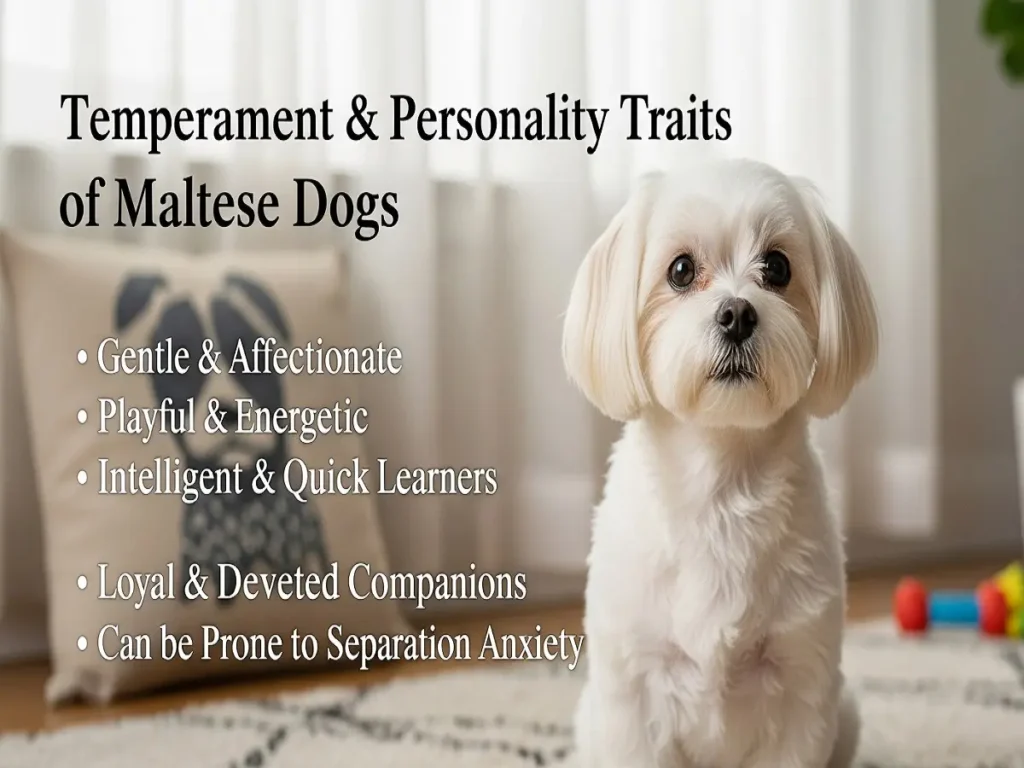
Every pup is an individual, but the typical Maltese dog temperament is affectionate and friendly, which is why they make good family dogs. From experience, I’ve seen how interactions with young children must be supervised, because rambunctious kids can accidentally hurt this tiny breed, while older children who understand how to interact are better suited.
These dogs form close bonds, prefer to be always by your side, and the breed can develop separation anxiety if left alone too long. Common traits and needs like barking, snoring, drooling, grooming, social needs, and digging all tie back to their deeply people-focused nature.
Personality of the Maltese Dog:
In terms of personality, the Maltese is gentle, intelligent, responsive, and trusting, yet also lively, playful, and vigorous, and generally enjoys learning tricks. They can be snappy with raucous kids, but their petite build belies a fearless presence
They are highly alert and elicit a flurry of responses to unfamiliar noises. Having lived around humans for over two millennia, the result is a dog that loves people, wants to be everyone’s best friend, and thrives as companions who build strong bonds with its owners. They aim to please, stay happy, are eager and easily trainable if you invest the time necessary, and respond well to positive reinforcement.
They can be protective of their families, may think they’re guard dogs, and are fun, perfect, energetic companions who, although they don’t need long walks every day, still match other breeds with similar energy levels. If you plan on adopting a puppy, keep in mind that early socialization will help create a well-rounded dog. Set aside time to socialize, try to invite friends, visit others, and bring your pup so it gets to know the outside world.
This process trains them to be confident, and because they crave attention, plenty of love and care is vital, or they become prone to anxiety. Before picking one up, give enough time to keep them balanced; according to the American Temperament Test Society (ATTS), 82.4% tested passed.
They are friendly, very social, often good with pets, a great choice for multiple households, curious, and thrive on interaction—a lack can make them feel anxious or lonely. These members love being held and cuddled, make excellent therapy dogs, and are loyal watchdogs, quite brave despite their size.
Appearance & Breed Standard:
| Feature | Breed Standard Description |
|---|---|
| Overall Appearance | Small, elegant, well-balanced body |
| Size | Toy breed |
| Weight | Up to 7 pounds |
| Height | 7–9 inches |
| Body Structure | Compact with a level topline |
| Head Shape | Slightly rounded skull |
| Eyes | Dark, round, alert expression |
| Nose | Black |
| Ears | Drooping, covered with long hair |
| Coat Texture | Long, straight, silky |
| Coat Length | Reaches the ground |
| Coat Color | Pure white |
| Tail | Plumed, carried over the back |
| Gait | Smooth, flowing movement |
| Expression | Gentle, intelligent, lively |
From hands-on experience, the smart, white-coated dog with a proud head carriage immediately stands out, not just in looks but in presence. This breed is lively, intelligent, and alert, with a naturally sweet-tempered nature that shows in daily handling.
The skull is gently rounded when viewed from the front and sides, never domed or apple-headed, with a stop that is well defined. The muzzle is broad, not snipy, slightly shorter from nose to stop than to occiput, keeping a ratio of 1:2, and finished with a black nose.
Oval eyes, not bulging, are dark brown with black eye rims and clear haloes, while long, well-feathered ears hang close to the head, their hair mingling with the coat at the shoulders.
The jaws are strong, forming a perfect, regular, complete scissor bite, where upper teeth closely overlap the lower, set square, and even. A medium-length neck leads to legs that are short and straight, with shoulders well sloped, supporting a well-balanced, essentially short, cobby body with good spring of rib, back level from withers to tail.
Breed Standard of the Maltese Dog:
The hindquarters show short legs, well angulatedthe ending in round feet with pads black. The tail is feathered, carried well arched over the back, and the gait/movement is straight, free, flowing, without weaving; when viewed from behind, legs are neither too close nor wide apart.
The coat is of reasonable length, never impeding action, straight, silky in texture, never woolly, crimped, and without undercoat. Colour is pure white, with slight lemon markings permissible, while any other colour or combination of colours is unacceptable. Size is defined by height not exceeding 25 cms (10 ins) from ground to withers, weight at male 4 lbs and female 4 lbs, and height (at withers) of male 10 in and female 9 in, finished with a coat that is long, straight, and white.
Grooming: Tools, Steps & Tear-Stain Solutions:

ready, clever, science explains why those reddish marks come from something called porphyrins, tiny molecules containing iron that pop up when red blood cells break down. These little troublemakers go hitching a ride in tears, saliva, wee, and other bodily fluids.
Just like rust on an old bike left in the rain, they darken in sunlight. In real life, this happens when tears remain on the coat too long and attract dirt, creating the same sort of reaction that can happen around a pet’s mouth when saliva remains on the fur.
Often, it’s not the fluids themselves that originally causing the problem; instead, the dirt they attract then causes a natural response to the irritant. In some cases there’s yeast, but Maltese tear stains are usually not a sign of any serious infection. In fact, they’re a sign eyes are reacting in a healthy way to irritants.
One of the prime things that irritates the eyes is the long coat you love. The first problem is fur that bounces into a beautiful face, irritating it, so regular grooming helps keep it clean. A top knot, or for a male, a man bun, can pull back hair that’s likely to fall forward.
Tools and Steps of the Maltese Dog:
Some owners even mix a home hair-dye mixture of 10% hydrogen peroxide and water to turn hair white, although stains likely return in a few days without other preventative steps. Of course, you worry a lot about where you get the formula to avoid eye damage; under no circumstances should you use bleach close to the eyes—seriously, what are you thinking, don’t do it.
The most attractive feature of this breed is its lush coat, which gives the dog a graceful, regal look. Walking one can feel like strolling with royalty. However, the bright white coat needs regular care and sits at the top of the grooming list, making maintenance a true labor of love.
Tear staining is incredibly commonenhancemakeyour; survey of 600 owners showed 93% reported having staining. Imagine humans who look punched; you can take steps to help prevent forming stains, give tips to rid them if you’re late in the game, and truly banish stubborn marks.
To keep your dog looking its best, you need more than a routine. You need the right tools that deliver real results. Petpost Tear Stain Remover helps restore your dog’s natural brightness with a gentle formula that targets stains at the source. It cleans safely without harsh chemicals and leaves dogs looking comfortable, clean, and happy.
Pair the Remover with a Comb to lift away debris effortlessly, protect the future before stains start, and let this dynamic duo enhance natural beauty, making your care routine quicker and more effective.
Settle for anything lesyours and it comes at the costo lift away debris effortlesslyt of furry friend’s care—invest in must-have products today, watch the coat transform,to lift away debris effortlessly,to powder-white fluff, which means more snuggle time for both of you. Grab them now, start seeing the difference.
When to Ring the Vet’s Bell:
When you ring the vet’s bell, it’s while stains are usually just a mean sign your pup needs extra attention, but sometimes they’re trying to tell you something serious. Shout if stains suddenly appear or get worse, eyes look angry or sore, the stained area starts smelling funny, or marks change their usual appearance.
More issues might include eye infections, corneal troubles, glaucoma, or wonky eyelids. Remember, keeping these areas dry is crucial; nobody wants unwanted bacteria setting camp on the face. Understanding what’s behind stains is the first step to keeping your best mate’s face fresh and bright.
Grooming Care for Daily Health:
In my experience, grooming is where owners notice the biggest daily impact on comfort and health. The extended, white coat of the Maltese needs brushing and examining on a daily basis, along with steady baths and taming, to prevent twisting and floorcovering.
Proper care helps keep the coat soft, looking good, and also helps prevent secondary health issues that arise when matted hair leads to skin irritation. Nails grow fast and require trimming, while pet owners should check ears every week to remove wax, debris, and excess hair.
The hair around the eyes must be cleaned to prevent tear stains, and as dogs grow older, they become prone to dental disease, so teeth should be brushed frequently.
Maltese Feeding & Nutrition Guidelines:

Balanced feeding and nutrition matter just as much as grooming. These guidelines show daily calorie needs, where adults usually require 200 calories per day, while puppies need around 400. Protein and fat sources should focus on formulas with real animal options like chicken, fish, and lamb, plus Omega-3 fatty acids for skin and coat health.
Meal frequency matters: pups under 6 months should eat 3–4 times daily to prevent low blood sugar, while adults eat 2–3 times. Portion control is key due to small size, with 1/4 to 1/2 cup of food total per day being sufficient, or 3/4 cup for larger 5+ lbs dogs. Treats should limit 10% of caloric intake to prevent obesity.
Health Risks & Vet Screening Checklist:
Luxating Patella and Core Health Risks:
In practice, Maltese health issues often appear subtle, even in two longhaired dogs sitting on a patio chair for a photo (think Adobe, Stock, deviddo vibes), because this generally healthy breed with an average lifespan of 12–15 years has few obvious concerns at first. Still, pet parents must be aware of inherited conditions for proper health management.
One common problem is a luxating patella, where the Maltese may develop an inherited condition affecting one or both kneecaps that pop out of place. Although patellar luxation is not generally considered painful, it may cause a dog to favor a leg.
Predispose them to knee injuries like cranial cruciate ligament tear and arthritis. Depending on severity, surgery is recommended to prevent further injury, improve quality of life, and reduce long-term risk.
Internal Conditions and Preventive Planning:

Heart and organ problems also matter. Patent ductus arteriosus (PDA) is an inherited condition where the ductus—a normal opening between two major blood vessels—does not close shortly after birth, causing blood to flow improperly, forcing the left side of the heart to work harder, and can lead to heart failure.
Responsible breeders screen puppies for abnormalities; depending on size, dogs may show minimal symptoms or severe signs like difficulty breathing, exercise intolerance, and stunted growth.
Surgery is typically the best option to close the defect; when done before the heart begins to fail, the prognosis is good, though some dogs developed heart failure may require medications afterward. Other concerns include liver shunts, where abnormal veins bypass the liver, affecting the filtration of toxins, wastes, and medications from the blood.
Affected dogs may have neurologic signs, disorientation, seizures, and poor growth. Dental disease is common in toy breeds, with periodontal problems like bad breath, red, inflamed gums, loose teeth, and painful symptoms that can damage organs if left untreated; the best way to keep the mouth healthy is daily at-home tooth brushing and routine cleanings under anesthesia.
Additional hereditary conditions include orthopedic issues, Legg-Calve-Perthes disease (LCPD) affecting the hips, white dog shaker syndrome with tremors, ear infections from hanging ears and limited air circulation, and portosystemic shunt anomaly.
Through preventive care, routine checkups, guidance from veterinary practitioners, and even pet insurance via Pawlicy Advisor to analyze personalized quotes and coverage pricing, owners can plan, watch for unusual signs, and support their pet’s future medical needs.
Maltese vs Other Toy Breeds (Comparison Table):
As of 2026, the Maltese remains a quintessential toy breed, instantly distinguished by a pure white, floor-length, silky coat and gentle temperament. It shares many traits with other toy breeds, such as small stature and high intelligence, yet key differences in grooming, energy levels, and size set it apart. From hands-on experience, this balance of elegance and awareness is what draws people in—and keeps them devoted.
Daily coat care matters because the single-layered hair does not shed like most dogs and requires daily brushing to prevent matting. Unlike the Pomeranian’s thick double hair, it’s similar to human hair.
The temperament is famously fearless and adaptable, yet generally more sensitive, prone to separation anxiety when compared to independent breeds like the Shih Tzu. For exercise, they’re energetic but have low-to-moderate needs, often satisfied with indoor play and short walks.
Making them ideal for apartment living over athletic types like the Toy Poodle. Fragility is due to their under-7-lb size; they’re more fragile than slightly larger counterparts like the Maltipoo, and better suited to households with older children.
Cost of Ownership USA 2026 Estimates:
Bringing Home a New Maltese: One-Time Costs
Dogs make perfect companions for people from all walks of life due to their adaptability and often friendly, playful natures, but caring for pups over an estimated 12–15-year lifespan can add a hefty financial commitment.
A Maltese may range between $50–$700 to adopt or $500–$2,000 from a breeder, with one-time costs, basic supplies, food, and extras like vet visit fees, procedures, spaying, neutering, medication, pet insurance, and grooming that can crop up unexpectedly, so being prepared helps you decide if parenting is right.
Free:
Sometimes, free options exist when people make a heartbreaking decision to rehome dogs they can no longer provide care for, choosing to send them to loving homes. Your best chance is to check rehoming websites, social media groups, and local listings.
Adoption:
With adoption, shelters and rescue organizations typically charge fees to cover general medical care and prevent ill intentions. Costs can range from $50–$700, depending on age and needs; puppies under 6 months are often more expensive.
Initial Setup and Supplies:
Initial setup supplies can total $215–$725, including important procedures like microchipping, vaccinations, spaying, and neutering, which vary by price, location, and service. Non-profit or reduced cost clinics may help during financial difficulty, using lower estimated figures.
How Much Does a Maltese Cost per Month? | Maltese Dog Guide
Ongoing cost per month averages $26–$300+, covering general health care while excludes environmental maintenance and entertainment. Basic food, heartworm, flea, and tick preventatives may go up if you opt for insurance, replacement items, chew toys, subscription delivery, or emergency veterinary treatment.
Health Care:
Health care ($26–$300+ month) is more than a vet visit; a big part is keeping dogs healthy by choosing a high-quality, complete, balanced formula suitable for their age. Add insurance to increase overall monthly cost, which may be worth thinking about if worried about potentially large treatment line items. (You may see a young vet checking a dog—Image, Creativa, Images, Shutterstock.)
Food:
Food costs $20–$50 per month for a bag of high-quality small breeds food that can last around a month, depending on brand. Wet food is more expensive (for example, $40 for 12 cans), so a budget option is a big dry bag to save money.
Grooming:
Grooming runs $0–$90 per month and is important, especially for long coats. A full session with a professional groomer is around $50; a nail trim or tooth cleaning costs $10–$15. The most economical option is to groom yourself.
Medications and Vet Visits:
Medications and vet visits cost $6–$100+ per month. Monthly flea, tick, and heartworm preventatives are advised, often sold in a box of six, averaging $6 per treatment. A checkup with basic care costs $30–$100, while emergency surgery or a special kind of care can reach upward of $1,000.
With pet health teleservices growing in popularity, you can get instant advice from the comfort of home at a fraction of the cost or speak online via PangoVet for affordable price support.
Adoption & Finding a Responsible Breeder:
Adoption Options:
From my experience helping families find the right small companion, starting with adoption is often the most humane choice. Platforms like Petfinder make it easier to find Maltese dogs in shelters, while Breed Rescue groups and American Maltese Dog Guide Association rescue programs support dogs needing a second chance.
Many Local Veterinarians stay aware of local reputable breeders as well as dogs in need of rehoming, which creates a quiet but reliable network for people who want to do the right thing without rushing into a purchase.
How to Find a Responsible Maltese Breeder?
If adoption is not possible, choosing a responsible Maltese Dog Guide breeder takes serious vetting, including in-person visits and strict health testing for liver issues, heart issues, and patella issues.
A trustworthy breeder usually grills you about your ability to care for the dog, which is a good sign, and follows clear Health Screening rules where parents are tested for luxating patella, heart anomalies like PDA, and liver shunts.
Expect In-Person Visits to a clean environment and home-based environment, detailed Breeder Interviews with many questions, and full Transparency where they openly show the puppies and their mother. Ethical breeders value Registration, Clubs, and members such as the American Maltese Association or the Royal Kennel Club, never sell in pet stores, and require returns.
IIf you cannot keep the dog, a responsible breeder will accept returns. They also explain red flags clearly, such as endless litters, selling puppies online without meeting buyers, or letting puppies go home before 12 weeks old while only taking payment.
FAQs?
Yes, many people search “maltese dog help?” when they need care tips, training advice, or health guidance. It usually means they want quick, beginner-friendly information about owning and caring for a Maltese dog.
Yes, Maltese dogs are friendly, small, and loving. With proper grooming and training, they are a great choice for first-time dog owners. Their calm and affectionate nature makes them an ideal companion.
Maltese dogs may face issues like dental problems, patella concerns, or liver conditions. Regular vet checkups, responsible breeding, and proper diet greatly reduce long-term health risks.
Maltese dogs need regular brushing, bathing, and eye cleaning to prevent mats and tear stains. Many owners choose professional grooming every few weeks to keep the coat healthy and manageable.
Both options work. Adoption helps dogs in need, while buying requires choosing a responsible breeder. Always avoid pet stores and prioritize health testing, transparency, and lifetime support.
Conclusion:
The Maltese Dog Guide is a loving, intelligent companion that thrives with proper care, grooming, and attention. By understanding their health needs and training requirements, owners can provide a safe and happy home. Choosing the right lifestyle fit also helps build a strong, lifelong bond with this charming breed.
