


What is a Japanese Chin Dog?
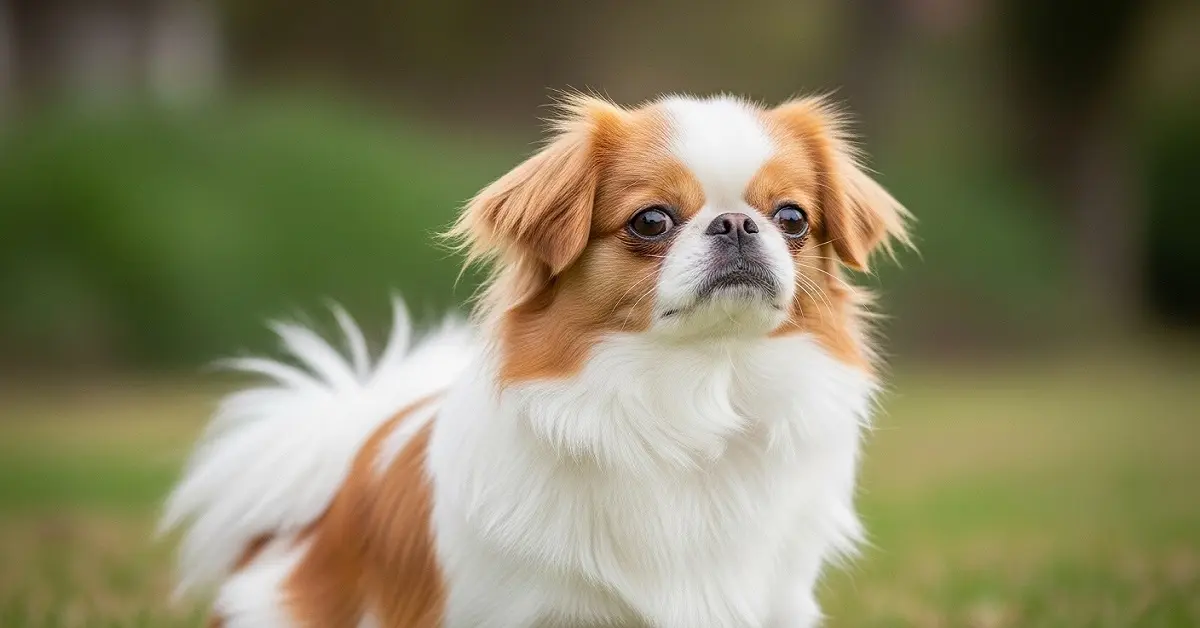
From my experience living with a Japanese Chin, this small, elegant, toy breed quickly feels larger than life. Originally favored by Asian royalty, this dog carries a calm confidence that shows in everyday moments. Known for its cat-like, affectionate, intelligent personality.
It is happy being a lap companion while also observing the room with quiet curiosity. With a history also known as the Spaniel, and written in Japanese script as 狆 (chin), the breed reflects a truly distinctive heritage shaped by closeness to people rather than work.
Physically, the Japanese Chin is easily recognizable, weighing 7–11 pounds and standing 8–11 inches tall. It features a short, flat face, a plumed tail, and a silky, long coat that feels surprisingly light in hand.
I have always noticed how quiet, clean, and ideal they are as indoor companions, especially when they often enjoy perching on high furniture. This gentle habit, paired with their calm nature, makes living with this toy breed both peaceful and deeply engaging.
Temperament & Personality of a Japanese Chin Dog?
Personality and Social Nature:
Japanese temperament is non-aggressive, gently home-friendly introductions, handle new, comfortable, peaceful coexistence, peacefully, cats and animals share dog park settings, multi-pet homes.
And adapt to non-dominant respect boundaries. From what I’ve seen, this calm social side shapes how the Japanese chin becomes a good companion, fitting easily into daily life while staying aware of others.
A sensitive, intelligent dog, albeit somewhat independent, whose only purpose is to serve as a responsive, affectionate friend with those he knows and loves, yet reserved around strangers or in situations that feel new.
Naturally clean and feisty, it makes an ideal pet that can thrive in any environment. Chins have a playful spirit that shines in their daily interactions, showing energetic play, love, and engaging active sessions.
Toy lovers, these dogs enjoy playing with soft toys, social playtime, get along well with other pets, games with interactive owners, indoor activities suited, chasing fun small objects, short bursts tend, and family brings joy and energy.
Temperament Characteristics:
Temperament Characteristics shape how a Japanese Chin fits into daily life as an affectionate, intelligent, toy breed with a charming, cat-like personality, often described by owners like me as calm yet expressive.
They are deeply devoted to families, enjoying cuddles and acting as loving lap dogs, while staying generally quiet and gentle. At the same time, they can be independent, reserved with strangers, and occasionally stubborn, which adds character rather than difficulty.
An Affectionate, Loyal nature helps them bond with owners, preferring the center of attention. Their Cat-like Personality shows as clean, quiet, and they prefer to jump to high places like the back of a couch or table.
Sensitive and Gentle, known for a delicate nature, they are well-suited to calm environments yet remain playful. Independent and Stubborn, but intelligent, they have a mind of their own, requiring patient, positive training.
Reserved with Strangers yet friendly, sometimes cautious or aloof around new people, acting as quiet watchdogs. With Low to Moderate Energy, they stay content with short walks, indoor playtime, ideal for apartment pets. Separation Anxiety can affect these people-oriented dogs if they suffer when left alone for a long period.
Appearance & Breed Standard:
Size, Proportion, Substance:
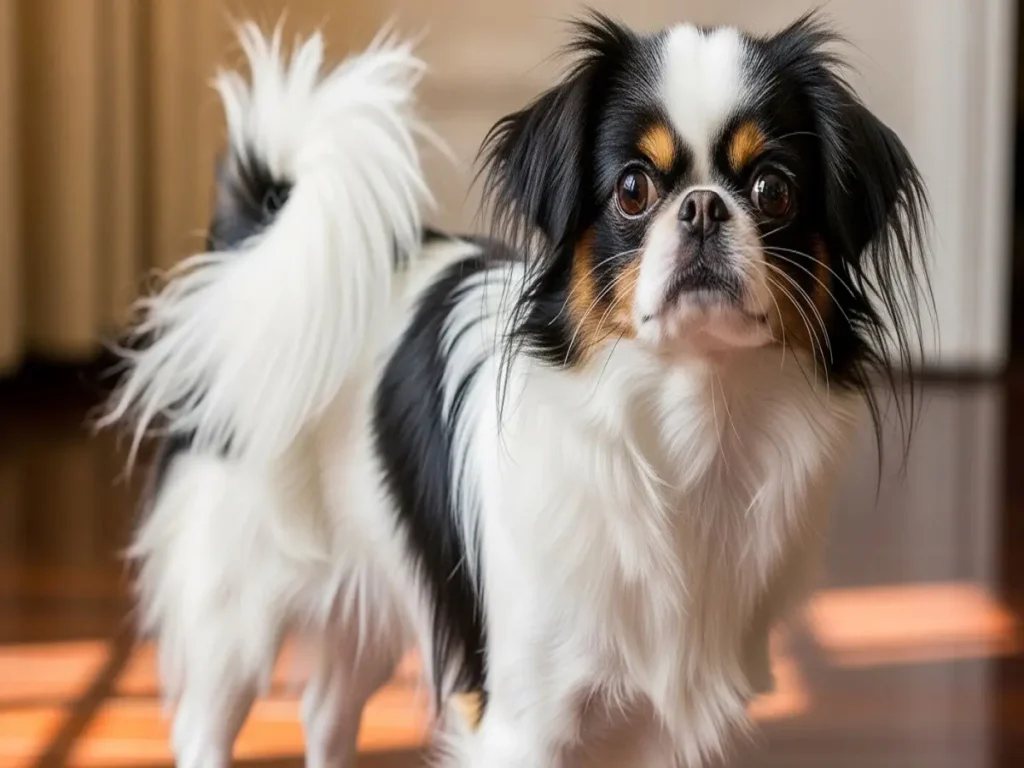
Size Ideal 8 11 inches at the highest point of the withers, with Proportion shown by Length between sternum and buttock equal to height. Substance feels solidly built, compact, yet refined, carrying good weight in proportion to body build, something I always check hands-on when evaluating structure.
General Appearance:
The Japanese Chin is small, well-balanced, lively, and aristocratic, a toy dog with a distinctive Oriental expression. Light, stylish action, a plumed tail carried over the back, curving to either side, and a coat that is profuse, silky, soft, and straight give a dog’s outline that presents a square appearance.
Head:
Expression bright, with a head that is short, broad, round, and deeply indented at the stop.
Characteristics:
An expression that is bright, inquisitive, alert, and intelligent defines this sensitive dog, whose only purpose is to serve man as a companion. Responsive and affectionate with those it knows and loves, yet reserved with strangers or new situations.
Skull:
A large, broad skull, slightly rounded between the ears, not domed, with a forehead prominent, rounding toward the nose, wide across the level of the eyes.
MUZZLE:
The nasal bridge is very short and wide, the nose set in a line with the eyes, cheeks well cushioned, and lips fully cover the teeth.
TEETH:
A full complement of strong, white teeth meets ideally in a level bite; Scissors or slightly undershot are acceptable. Missing or misaligned teeth are not severely penalized; Faults include Overshot or wry mouths.
The breed is sensitive to oral examination, though the UKC judging procedure, handler, show, and Judge rarely present a problem.
EYES:
Large, round eyes, set wide apart, lustrous, dark in color, with a small amount of white at the inner corners, a breed characteristic giving a look of astonishment.
EARS:
Small, hanging, V-shaped ears, set wide apart, slightly below the crown of the skull, alert and carried forward and downward, feathered to fit the rounded contour of the head.
NOSE:
A nose that is very short, with wide open nostrils, level with the middle of the eyes, and upturned. Black, white, dog, tan points, pigment, red, or self-colored apply by color pattern.
Neck:
Rather short and upright, carrying the head high.
Forequarters:
Elbows set close to the body.
FORELEGS:
Forelegs straight, fine boned. Removal of dewclaws optional.
Body:
The body is square, with a chest moderately wide, ribs somewhat rounded, depth that extends to the elbow, a back straight, and a loin broad, slightly rounded.
Hindquarters:
HIND LEGS rear legs fine-boned, straight when viewed from the rear, with moderate bend at the stifle. Removal of dewclaws is optional.
Feet:
Feet hare-shaped; Forefeet point straight ahead or slightly outward; Hind feet straight. In mature dogs, there is feathering at the ends of the toes.
Tail:
Tail set high, carried arched over the back, flowing to either side of the body.
Coat:
The breed is single-coated with an abundant coat, silky and straight, resilient in texture, with a tendency to stand out from the body. Neck, shoulders, chest, thick mane, ruff, head, muzzle, short hair, feathered ears, forelegs, blending into profuse legs, rump, culottes, pants, hock joint, foot, and plume.
Color:
Acceptable colors include black, white, red, tan points, with shades of orange, lemon, and sable, intermingled or overlaid. Spots on eyes, ears, cheeks, and anal vent; clearly-defined muzzle and blaze preferable, symmetry of facial markings, placement, patches of lesser importance, clear white without excessive ticking.
Height:
The ideal height for males is ten inches, slightly less for females.
Gait:
The Japanese Chin’s gait is elegant, light, and proud.
Daily Care Guide: Grooming of a Japanese Chin Dog
Exercise & Enrichment:
From daily experience, Japanese Chins are not a high-energy dog but enjoys daily light activity. A Daily Activity, like a 20–30 minute walk or a few short playful sessions, is sufficient. Indoor Play is a favorite; they love games, fetching small toys, and often engage in the Chin spin, a dancing motion.
For Safety, use a harness rather than a collar, as brachycephalic dogs can suffer breathing difficulties, especially in hot, humid weather. Mental Stimulation with Puzzle toys and gentle training sessions helps keep their minds active.
Grooming Needs:
The Japanese Chin is charming and cat-like, a toy breed requiring moderate, low-intensity care tailored to a brachycephalic, flat-faced nature. They thrive on companionship, daily light exercise, and regular brushing to prevent tangles in a long, silky coat, within a comfortable climate-controlled indoor environment.
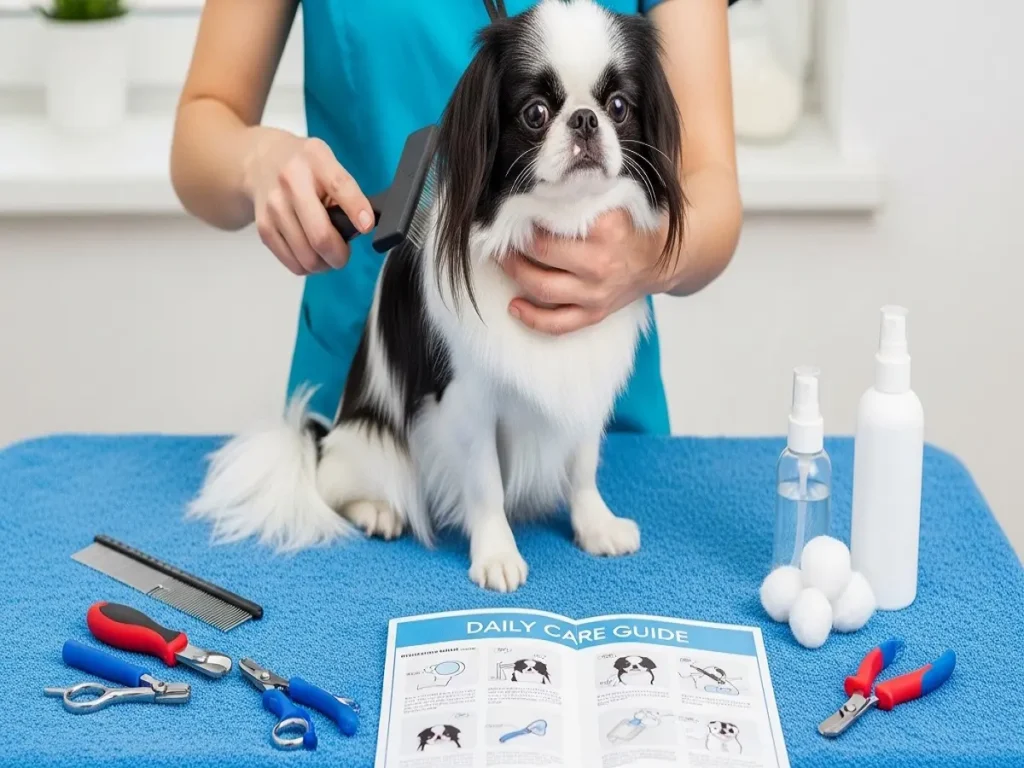
Despite a luxurious appearance, they are relatively low-maintenance, though hair requires consistent care to prevent matting. Brushing means brushing 3–4 times per week with a soft pin brush to remove and manage shedding. Bathing involves a bath every 4–6 weeks, usually sufficient.
Eye Care is vital; prominent eyes prone to injury and tearing should be checked daily and wiped with a damp cloth or pet-safe wipe to prevent tear staining. Nails & Ears need attention: Trim nails monthly as they grow fast to avoid painful overgrowth, and Clean ears every 2–3 weeks to stop debris build-up.
Dental Care includes brushing teeth regularly to avoid dental disease. The long coat benefits from regular brushing every few days to prevent tangles and matting; a monthly routine helps keep it clean, checked, and washed weekly with a gentle dog-friendly cleanser like Orvis.
Environment & Lifestyle Needs:
These dogs are companion animals designed for indoor, refined living. Indoor Living suits them; they are perfectly suited to apartments or smaller homes, often perched on the back of chairs or couches like cats.
Temperature Sensitivity matters because they cannot tolerate high heat or extreme cold, and must be kept in air-conditioned environments during hot weather. Safety Requirements include a secure fenced yard; they can be curious and sometimes disobedient off-leash. Separation Sensitivity is real; they do not enjoy being left alone and may develop separation anxiety if isolated for long periods.
Never leave them outside by themselves, even for potty breaks; Birds like hawks and owls may mistake them for dinner and try to carry them away. To keep them safe, always stay with your pup out in fields, advice echoed by Chewy on Dec 15, 2025.
Daily Routine Summary:
A Daily Routine Summary works best: Morning Short 15-minute walk; Midday Check eyes for tear stains, quick brushing if needed, and a short play session; Evening walk or indoor game of fetch, then cuddle time.
Health & Vet Checklist — risks, prevention, symptoms of a Japanese Chin Dog:
GM2 Gangliosidosis:
Similar to Tay-Sachs disease in humans, GM2 gangliosidosis is fatal, inherited, and only found in the Japanese Chin breed. It causes the nervous system to lose function, leading to incoordination, intention tremors, violent shaking of the head, loss of vision, difficulty eating, and altered behavior.
First symptoms are typically observed at 12–18 months of age. The disease progresses rapidly, resulting in poor quality of life, and humane euthanasia is often pursued within a year of onset. It is preventable when breeders genetically test the breeding line and do not breed dogs with a genetic mutation in their DNA.
Brachycephalic Airway Syndrome (BAS):
Japanese Chin flat-faced brachycephalic dogs may experience brachycephalic airway syndrome, which results in difficulty breathing due to anatomy. Signs include snoring, snort, breathe heavily, gag, or cough more often than breeds with shorter muzzles.
This condition makes them highly sensitive to warm temperatures and susceptible to overheating. Special care is needed in humid or hot weather, limiting exercise to cooler times of the day.
Obesity can make symptoms worse, so keep a healthy weight. In severe cases, corrective surgery to widen nostrils or trim the soft palate—the section of the roof of the mouth that separates the nasal passage from the oral cavity may be recommended.
Luxating Patella:
Patellar luxation occurs when the kneecap moves (luxates) out of place, most often due to a shallow groove in the femur. There are varying degrees, with severe cases requiring orthopedic surgery.
A reputable Japanese Chin breeder will have evaluated dogs before breeding to make sure those without the medical condition are used for breeding purposes.
Cataracts:
A cataract is a cloudy lens within the eye. Small cataracts are visible only with the aid of an ophthalmoscope, while large ones are easy to see as the pupil becomes completely white. Larger cataracts cause significant loss of vision. Japanese Chin can develop cataracts when young, as early as 4 years old. They are usually hereditary, so family history matters
Entropion:
Entropion occurs when eyelids roll inward toward the eye, causing fur and eyelashes to rub the surface of the cornea. This painful condition can lead to corneal ulcers. It is usually diagnosed in Japanese Chin puppies and can be corrected with surgery. Dogs with a history of entropion should not be bred.
Distichiasis:
Distichiasis is an inherited condition that causes extra eyelashes to grow on the eyelid, pointed towards the eye. These lashes rub the surface, causing irritation and sometimes corneal ulcers.
To prevent it from being passed to future generations, it is best to breed Japanese Chin without a history of distichiasis.
Heart Disease:
Heart Disease such as Myxomatous mitral valve degeneration (MMVP) can develop in the Japanese Chin. It refers to degeneration between the left atrium and ventricle. Leaflets become deformed, preventing opening and closing completely, allowing blood to flow backwards (mitral regurgitation).
This leads to a heart murmur detected during a routine physical exam. As it progresses, symptoms include coughing, lethargy, and respiratory distress. Medications may be prescribed to slow progression and delay congestive heart failure.
Related issues include luxating patellas, slipping kneecaps, cataracts, and early-onset murmurs. A short, flattened face can cause breathing problems in extreme situations and severe weather.
Symptoms to Monitor (When to See a Vet):
Respiratory signs include Wheezing, snorting, excessive panting, blue gums, or fainting. Mobility issues include hopping, skipping, bunny hopping with rear legs, or reluctance to jump or use stairs.
Eyes may show Squinting, rubbing, excessive tearing, cloudiness, or discharge. Behavioral changes include sudden lethargy, weight gain or loss, bad breath, separation anxiety, barking, or destruction. Neurological signs include balance issues and head tremors.
Prevention & Care Checklist:
Heat Safety is key for an indoor dog that does not tolerate heat—restrict exercise in warm weather to prevent heatstroke. Dental Hygiene: Brush teeth at least 2–3 times per week or daily to avoid periodontal disease, which can shorten lifespan by 1–3 years.
Weight Management: keep them slim to avoid extra stress on joints and the heart. Eye and Coat Care: clean eyes for tear stains, and long silky coat 3–4 times per week to prevent tangling. Use a harness instead of a collar to avoid pressure on delicate necks.
Vet Screening (Recommended by JCCA):
Vet Screening Recommended by JCCA includes Eyes Exam by a board-certified ophthalmologist at 36 months, Heart Exam after 4 years of age, Patella Evaluation at 1 year, and DNA Test for GM2 Gangliosidosis.
Nutrition & Feeding Plan — toy breed specifics of a Japanese Chin Dog:
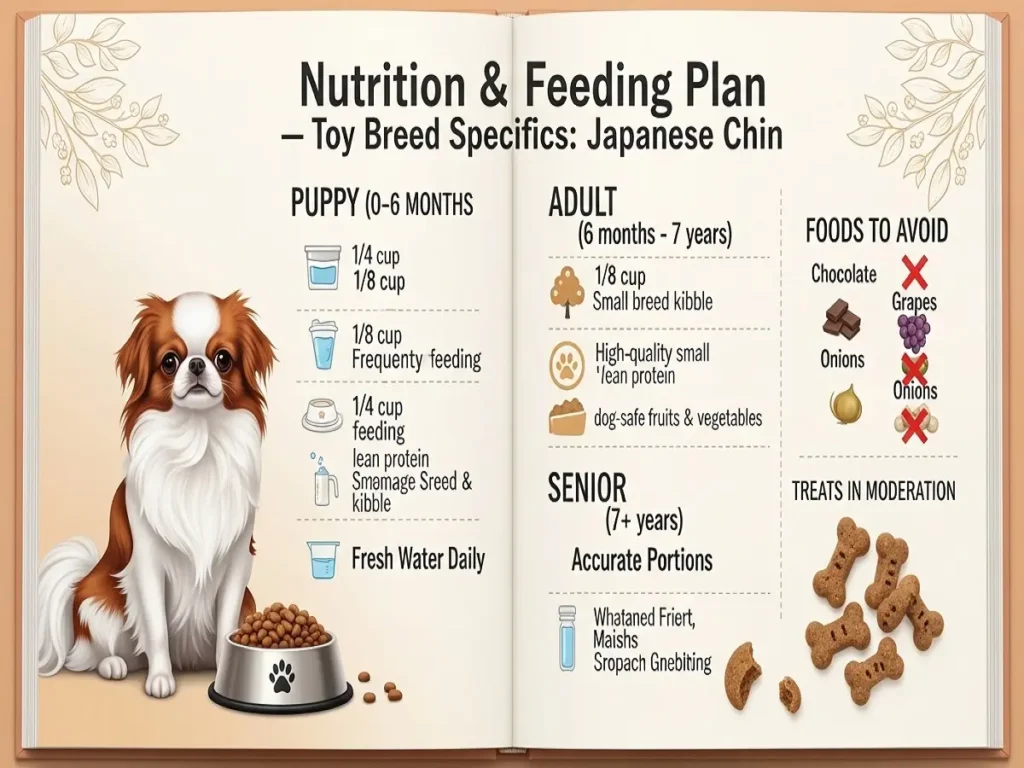
How To Feed a Japanese Chin:
From my experience, How, To, Feed a Japanese Chin depends on their small body frame and the best routine for this breed. It helps to feed three times a day, morning, midday, and evening, to prevent hypoglycemia.
Puppies under 1 year of age should be fed small-breed, high-quality puppy formula with higher calories to allow proper growth. Once a Chin turns old, with no further growth that will occur, the diet should be slowly transitioned to adult dog food.
I always talk to a vet about when to switch to senior food, since some diets start at 8 years, while others are given at 12 or more.
What Do Japanese Chins Eat? Food and Nutritional Requirements
What they eat matters just as much. Japanese Chin food and nutritional requirements should stay simple, balanced, not fancy or extreme diets. These small dogs need high-quality nutrition in small amounts, where every meal gives enough energy and nutrients without extra calories.
A healthy diet is built around four main nutrients: protein, fat, carbohydrates, and fiber, and each plays a clear role in the body. It’s important to feed high-quality dog food that meets nutritional standards set by the American Feed Control Officials (AAFCO) through rigorous testing, with the proper amount of nutrients.
I always talk with a veterinarian to choose the best puppy plan, where the daily diet should consist of 90% food formulated for their age and no more than 10% treats.
How Much Should You Feed a Japanese Chin?
When owners ask How, Much, Should, You, Feed, a Japanese Chin, I point them to follow the feeding guidelines on AAFCO-approved dog food packaging to find guidance. Talking to a veterinarian gives better information, helping tailor a recommendation specifically based on weight, health, life stage, and lifestyle. Always measure the food for each meal to ensure the proper amount.
Nutritional Tips for Japanese Chin:
Simple Nutritional Tips matter. A Japanese Chin should receive all essential nutrients from AAFCO-approved dog food, so they shouldn’t need supplements. However, sometimes a veterinarian will recommend a supplement if needed. Never give a pup anything without veterinary guidance.
Behavior and Training Tips for Japanese Chin:
Good feeding ties into Behavior and Training Tips. This guide explains exactly what to feed, how much, and how to choose the best food for each life stage. Nutrition is not just small dog food by a different name; this toy breed has a compact body, delicate bone structure, short muzzle, and relatively low daily calorie needs.
Feeding mistakes show faster than in larger dogs. Extra treats, table scraps, or oversized portions quickly lead to weight gain, digestive upset, and long-term health issues. As indoor companions with moderate activity levels, their diet must deliver high nutritional density without excess calories every bite matters.
The right balance of protein, fats, carbohydrates, and micronutrients supports lean muscle, healthy skin, coat, stable digestion, dental health, and consistent energy, while the wrong diet can contribute to obesity. A small stomach capacity means large meals don’t work well; rapid metabolism makes portion accuracy critical.
Toy breeds:
Toy breeds gain and lose faster than medium or large dogs, and dental crowding increases the importance of texture and chewing habits. This plan is designed to help make clear, practical decisions when raising a puppy, maintaining an adult, or supporting a senior.
Owners learn what they actually need, avoid the most common mistakes owners make, choose calorie-controlled, easy-to-digest, sized for mouths, best, complete, balanced, small-breed food with animal protein, moderate fat, gentle rice or oats, feed two meals per day, keep treats under 10%, and adjust portions by activity level.
Training & Behavior Solutions of a Japanese Chin Dog:

Build Attention First:
I always build attention first because training starts with connection. I start teaching my dog to focus on you. I say my dog’s name once, and when they look, I reward right away. This builds a habit of paying attention before asking anything else. I practice this for a few days before moving on, and I have seen how this simple step makes later training calmer and clearer.
Step 2: Teach One Skill at a Time
With Step 2, I Teach one skill at a time. I work on only one cue, like sit or come. I say the word once, show the action, and reward when my dog tries. I do not repeat many times because repeating confuses. This focused method helps the dog understand without pressure.
Step 3: Reward at the Right Moment
In Step 3, I Reward at the right moment. I give the reward the second my dog does the right thing. Fast rewards help them understand which behavior earned the treat. Late rewards slow learning, something I learned early through trial and error.
Step 4: practise in small steps
For Step 4, I practice in small steps. I start training in a quiet space. Once my dog does well, I slowly practice in other rooms, then outside. I do not rush this step because moving too fast can cause setbacks, especially with sensitive dogs.
Step 5: Practice Real-Life Skills
Step 5 is about practicing real-life skills. I use training in daily life. I ask for a seat before meals, and come pick up my dog, and calm behavior when greeting visitors. This helps dogs use their skills outside training time, which makes life easier for both of us.
Behavioral Solutions & Tips:
For Behavioral Solutions Tips, I respect their Cat-like Behavior and provide safe, elevated spaces like the back of a couch so they can perch and observe. With Separation Anxiety, these companion dogs dislike being alone, so I focus on building confidence.
For Exercise and Breathing, I avoid strenuous activity in hot or humid weather due to flat faces and being brachycephalic. During Chewing and Teething, I utilize teething toys, and when necessary, an enzyme cleaner for accidents helps manage puppy behavior.
Costs & Buying/Adoption Guide (USA) of a Japanese Chin Dog:

Buying vs. Adoption Costs (2026):
In the USA, purchasing a Japanese Chin puppy from a reputable breeder typically costs between 1,500 and 3,500, with prices varying based on pedigree, breeder reputation, and show-quality potential, with females often higher.
Rescue Adoption is significantly cheaper, ranging from $100 to 600, with adults more common than puppies, and often includes vaccinations, spay neuter surgery, and health checks. Initial Setup Costs run 150 to 300 for crate, toys, grooming tools, and food, while Monthly Expenses average 50 to 90 for routine vet visits.
Finding a Reputable Breeder:
The Buying Guide for Finding a Reputable Breeder matters because Japanese Chins are relatively uncommon, and finding one is crucial to avoid health issues like heart and breathing problems they may suffer. Use Breeder Referrals and contact the Japanese Chin Club America (JCCA) for a list of responsible breeders.
Good Dog and other reputable platforms and websites screen for health testing, temperament, and ethical standards. Look for breeders who provide clearances for parents, including OFA (Orthopedic Foundation Animals) testing for eyes, patellas, and heart checks, and Avoid Puppy Mills and Scams, especially Facebook groups promising low prices like 600 with complex shipping, which are often scams.
Adoption and Rescue Options:
The Adoption Guide highlights Rescue Organizations such as JCCARE (Japanese Chin Care Rescue Effort), a primary national non-profit organization dedicated to rescuing and rehoming Japanese Chins.
Regional Rescues like Colorado Japanese Chin Rescue (CJCR) offer specialized, thorough adoption processes with home checks and interviews. Special Needs adoption of seniors or dogs with minor health issues is cheaper, sometimes between 100 and 200.
Ownership Costs and Lifestyle:
Ownership Costs Considerations include Health risks tied to short, flat faces, making them prone to respiratory and heart issues, so pet insurance (25 to 50 per month) is recommended. Grooming needs are steady, with long, luxurious coats needing weekly brushing and monthly baths to maintain condition.
Their Lifestyle suits excellent apartment dogs, requiring moderate, gentle exercise, and the Chin Spin is a common, endearing behavior, where they spin in circles on two legs when excited.
Red Flags When Buying:
Watch for Red Flags Buying, especially No Health Testing, where a breeder cannot show genetic results for parents—do not buy. Shipping via Cargo is another warning, as reputable breeders prefer to meet in person or use a flight nanny rather than shipping a puppy. Unrealistic Pricing, with extremely low prices that seem too good to be true, are offers frequently scams.
Asian Breed Comparison:
Unlike similar Asian breeds like the Pekingese, the Chin has a thinner coat, a slightly taller stature, and a more delicate build. From hands-on experience, these traits make them affectionate companions best suited for indoor life, where their light structure and calm nature truly shine.
Japanese Chin vs. King Charles Spaniel:
When comparing apanese Chin vs. King Charles Spaniel, their Appearance can look similar, and it is suspected the breeds were crossed historically. The key Distinctions are that the Japanese Chin typically shows a slightly more Oriental expression, with wider-set eyes, and a straight, less wavy coat when compared side by side.
Japanese Chin vs. Other Japanese Breeds:
Looking at Japanese Chin vs. Other Japanese Breeds, such as e.g., Shiba Inu and Akita, the Purpose is very different. Shiba Inus and Akitas are working dogs originally bred for hunting or guarding, while the Chin was bred exclusively as a companion lapdog for the aristocracy. In Size, the Chin is significantly smaller, a true toy breed, unlike the medium-to-large build of other Japanese dogs.
Breed Comparison Table (Overview):
| Feature | Japanese Chin | Pekingese | King Charles Spaniel | Shiba Inu | Akita |
| Breed Type | Toy / Companion | Toy / Companion | Toy / Companion | Working / Spitz | Working / Guardian |
| Origin | Japan | China | United Kingdom | Japan | Japan |
| Original Purpose | Companion, lapdog for aristocracy | Imperial companion | Royal companion | Hunting | Guarding & hunting |
| Size | Small (Toy breed) | Small (Toy breed) | Small (Toy breed) | Medium | Large |
| Build | Delicate, refined | Stocky, compact | Slightly sturdier | Athletic | Powerful, heavy |
| Coat Type | Thin, straight, silky | Thick, heavy, long | Silky, slightly wavy | Dense double coat | Dense double coat |
| Facial Expression | Oriental, wide-set eyes | Flat, bold expression | Soft, rounded | Fox-like | Broad, strong |
| Energy Level | Low to moderate | Low | Moderate | High | Moderate |
| Temperament | Affectionate, gentle | Loyal, reserved | Friendly, outgoing | Independent, alert | Calm, protective |
| Indoor Suitability | Excellent | Excellent | Good | Moderate | Moderate |
| Exercise Needs | Light | Light | Moderate | High | Moderate |
| Good for Apartments | Yes | Yes | Yes | Sometimes | No (better with space) |
FAQs?
The Japanese Chin dog is known for its elegant looks, cat-like behavior, and affectionate nature. This small companion breed is quiet, intelligent, and forms strong bonds, making it ideal for calm households and apartment living.
Yes, the Japanese Chin dog adapts very well to apartment life. Their small size, low exercise needs, and calm indoor behavior make them perfect for limited spaces, provided they receive daily interaction and gentle playtime.
Japanese Chin dogs are intelligent but sensitive. They respond best to positive, reward-based training. Harsh methods can cause withdrawal, while short, fun sessions with praise help build trust and encourage good behavior.
Like many toy breeds, the Japanese Chin dog can face issues such as breathing difficulties, heart concerns, and eye problems. Regular vet checkups, proper weight control, and careful grooming help reduce health risks.
The Japanese Chin dog can be good with calm, respectful children.
Because of their delicate size, they suit families with older children who understand gentle handling and appropriate interaction.
Conclusion:
Moreover, the Japanese Chin builds a graceful companionship through history, refinement, and strong human bonds. Its small size, gentle energy, and expressive features make it especially suited for indoor living and modern homes.
Beyond appearance, the breed stands out for its emotional awareness and devotion to people. When cared for thoughtfully and trained with patience, the Japanese Chin offers not just companionship, but a calm, comforting presence that blends elegance with warmth in everyday life.
